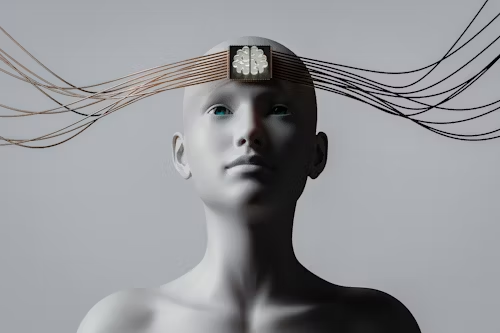
Revolutionary AI Language Model Achieves Human-Like Nuance
Scientists unveil a groundbreaking AI capable of understanding and generating complex linguistic structures with unprecedented accuracy, promising new frontiers in communication.
In a monumental stride for artificial intelligence, researchers at the Global Syntactical Institute announced today the successful development of "Lexicon-GPT," an advanced large language model that demonstrates remarkable proficiency in capturing the subtle nuances of human conversation. Unlike previous iterations, Lexicon-GPT exhibits an uncanny ability to navigate idiomatic expressions, sarcasm, and even poetic language, making its generated text virtually indistinguishable from human-authored content. This breakthrough is expected to revolutionize fields ranging from automated customer service and content creation to educational tools and therapeutic communication. Experts suggest that the model's deep understanding of grammatical dependencies and semantic relationships is key to its success, allowing it to construct coherent and contextually relevant narratives. The project, funded by a consortium of international tech giants, is currently undergoing rigorous ethical review to ensure responsible deployment. Early applications are already being explored in personalized learning platforms, where Lexicon-GPT could adapt to individual student learning styles and provide tailored feedback on writing assignments. Furthermore, its potential in cross-cultural communication, by translating not just words but also cultural contexts and tones, is immense. The team credits years of dedicated research into computational linguistics and neural network architectures for this significant achievement. The implications for the future of human-computer interaction are profound, potentially leading to more intuitive and empathetic digital assistants. However, concerns about job displacement and the spread of misinformation also accompany this powerful new technology, prompting calls for robust regulatory frameworks. The institute plans to release a white paper detailing the model's architecture and training methodologies next month, inviting global collaboration on its future development and ethical guidelines. This advancement marks a pivotal moment in the ongoing quest to bridge the gap between human cognition and artificial intelligence, pushing the boundaries of what machines can comprehend and articulate.
Read More →